VR Arena Cost Explained
VR arena cost is often misunderstood because the word arena can mean very different things. One supplier may use it for a small group VR room. Another may mean a mapped free roam battlefield. A third may be selling fixed headset stations under an arena brand. Before asking what a VR arena costs, the buyer has to define what the venue is supposed to do.
In 2026, that definition matters. Commercial landlords and entertainment operators are more careful with floor area, staffing, and repeat revenue. A VR arena should not be a pile of devices in a rented unit. It should be a location-based VR attraction with a clear player flow, a saleable session, and a support plan. MiXR’s VR Large Space product can be used as a reference for buyers who want the arena to operate as a multiplayer business, not a one-time demo.
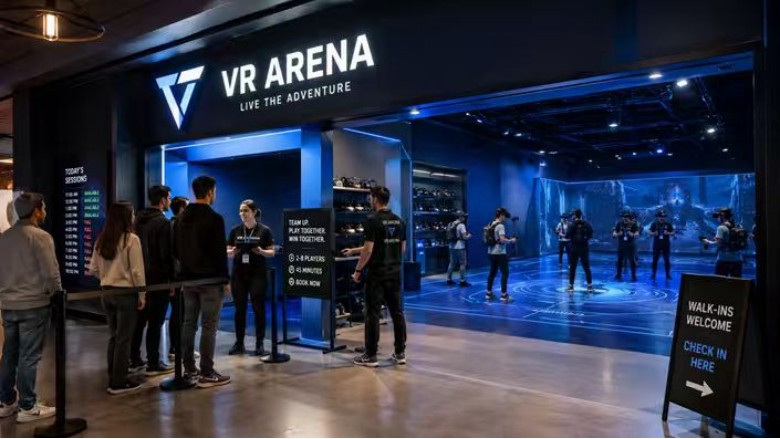
The cost depends on the arena type
A compact arena with limited movement will have a different scope from a full free roam VR arena. The compact version may suit malls with light traffic or small entertainment corners. The larger format needs more space, tracking design, player management, content choice, and safety planning. It can also carry stronger group-ticket value when the venue has enough visitors.
The buyer should look at the room before looking at the product name. Usable area, ceiling height, columns, lighting, ventilation, fire exits, waiting space, and staff visibility all affect cost. A poor room can make a good equipment package expensive to operate.
What is usually included
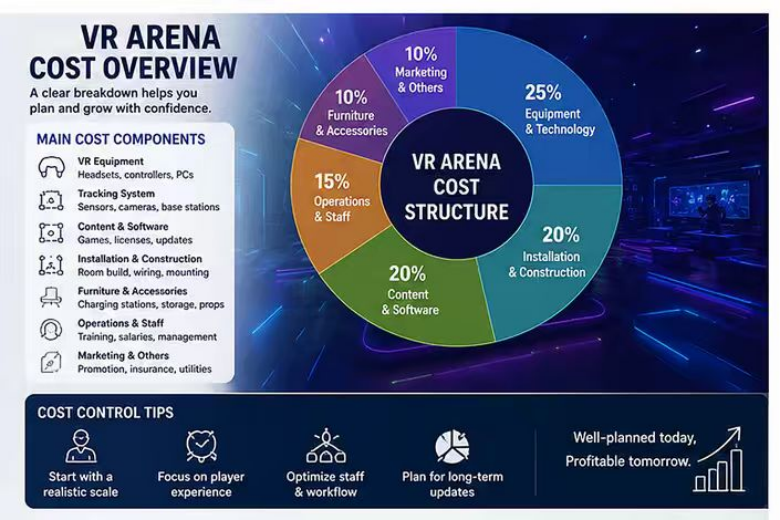
A serious VR arena budget may include headsets, controllers or interactive props, tracking system, computing equipment, local network, operator screen, charging and cleaning setup, multiplayer software, content library, installation, calibration, and training. Some suppliers include content updates or spare parts. Others quote them separately. That difference is easy to miss.
Owner-side costs should be listed separately: rent, decoration, wall protection, electrical work, HVAC, signage, queue management, ticketing system, insurance, and opening marketing. If the owner wants a storefront that pulls traffic from the corridor, design and signage are not cosmetic extras. They are part of sales conversion.
There is also the cost of mistakes. A room with poor air flow makes headset play uncomfortable. A storage area placed too far from the staff point slows reset. A waiting line that blocks nearby tenants creates complaints. These are not VR hardware problems, yet they often become VR business problems.
A clean cost comparison method
- Write down the exact arena format: fixed station, compact multiplayer, or free roam VR.
- Compare practical player capacity, not the highest number in the brochure.
- Ask for the real cycle time including onboarding and reset.
- Mark every excluded site item in a separate owner-side budget.
- Check whether content, props, training, and remote support are included.
- Run the business case on ordinary weekdays before using weekend peak traffic.
Where arena costs surprise buyers
Reset time is one surprise. A game may last 8-12 minutes, but staff still need to fit headsets, explain controls, clean contact areas, manage batteries, and prepare the next group. Another surprise is staffing. A venue that expects one employee to sell tickets, onboard players, monitor the game, clean equipment, and solve technical faults may be asking too much.
The third surprise is content life. A VR shooting arena can open strongly, but repeat visitors will ask what else is available. If the project has no content refresh path, the initial investment has to work harder.
Buyers should ask suppliers to show the daily operation list. Who starts the system? Who checks tracking? Who cleans props? Who records a fault? Who explains the mission when a group is nervous? If those answers are vague, the lower quote may be hiding labor that the venue has not planned.
When the cost makes sense
A VR arena is a sensible investment when the venue has visible traffic, enough room for safe movement, a clear audience, and staff who can run sessions without improvising. It is not a good fit for hidden spaces, very narrow rooms, or operators who only want a low-maintenance display.
For many operators, the safer approach is to match the first arena size to normal traffic, then expand content or player capacity later. The attraction does not need to be oversized to look serious. It needs to be busy, understandable, and easy enough for staff to run.
If the first version runs cleanly, the operator can add new missions, stronger decor, or more event packages with better confidence. Expansion is easier after the team understands real visitor behavior.
A buyer should ask MiXR or any VR arena supplier to explain the complete operating model. What does the visitor see from the corridor? How does the session start? How many players can the room handle per hour? What are the failure points? When those answers are clear, the cost discussion becomes much less theatrical and much more useful.