Free Roam VR Cost Analysis
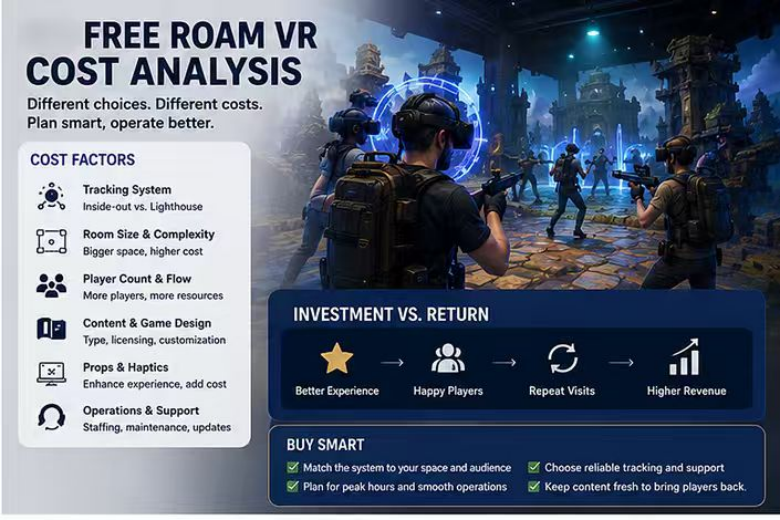
Free roam VR cost analysis gets messy when buyers treat every open-room VR attraction as the same thing. The phrase sounds simple: players walk freely inside a virtual world. In practice, the budget changes with room size, tracking method, player count, content type, props, staff workflow, and how much responsibility the supplier carries after delivery.
In 2026, commercial venues are asking harder questions because free roam VR is no longer judged by a first-weekend crowd. A mall operator wants repeat sessions. A family entertainment center wants party packages. A tourism retail block wants a paid attraction that can work during weak weather or evening hours. MiXR’s VR Large Space solution fits this category when the buyer needs a multiplayer location-based VR attraction rather than a small headset trial area.
The main cost drivers
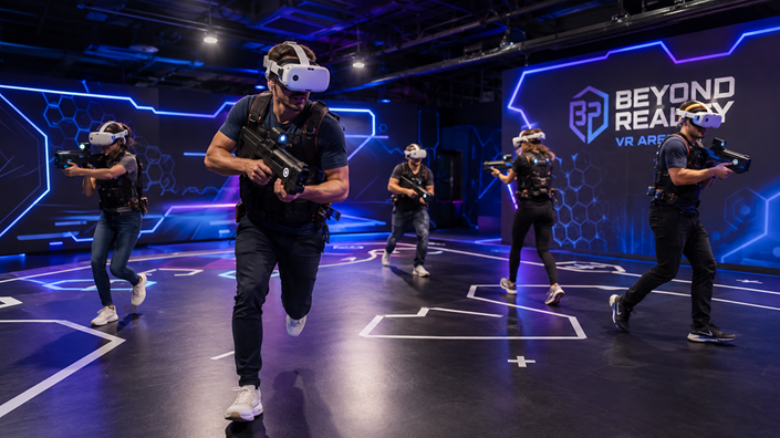
The first driver is the number of simultaneous players. More players mean more headsets, more tracking points or tracking load, more props, stronger network planning, and more staff attention. It also affects the business model. A system that handles 8 players per round can sell group tickets differently from a two-player setup.
The second driver is the physical room. A clean rectangular room is easier to map than a space with columns, glass walls, low ceilings, or awkward entrances. The venue may need wall padding, floor treatment, air-conditioning improvements, cable routes, lighting control, storage, and a place for cleaning and charging equipment. These are cost items even when they are not listed under VR equipment.
The third driver is content. A free roam VR shooter with weapon-shaped props needs a different hardware and safety plan from a family exploration mission. A tourism-themed project may need localized story elements. A venue that wants regular updates should ask how content refresh is priced and scheduled.
How to read a supplier quotation
A useful quotation should tell you what is included, what is excluded, and what the owner must prepare before installation. I would be cautious with any offer that looks attractive but does not mention room requirements, calibration, staff training, spare parts, and support procedures. Those items do not disappear. They simply move into the owner’s problem list.
The quote should also separate one-time project work from future operating costs. Content updates, replacement face cushions, batteries, damaged props, cleaning supplies, and staff training for new employees may not be large line items one by one, but they shape the attraction’s real economics. A buyer who asks about these items early usually has fewer surprises after opening.
- Check player count and actual round cycle before comparing prices.
- Ask whether the quote includes tracking setup, content, props, and operator software.
- Separate decoration, HVAC, power, flooring, and local construction from the supplier scope.
- Confirm what happens when equipment needs repair or replacement.
- Ask for a launch checklist instead of stopping at an equipment list.
- Model weak weekday traffic before using holiday attendance in ROI planning.
Do not let the demo video set the budget
Demo videos are useful, but they hide the slow parts of the business: ticket checking, headset fitting, player nervousness, cleaning, battery rotation, and staff reset. A venue that ignores those details may buy a system that looks strong online and runs slowly on site.
When free roam VR is worth the heavier scope
Free roam VR makes sense when movement is part of the attraction value. If visitors are meant to walk with friends, cover each other in a mission, explore a mapped world, or compete as teams, the extra planning has a commercial reason. The format supports birthdays, youth traffic, company events, and repeat challenges better than many single-player VR stations.
It also gives the venue stronger marketing language. Staff are not selling a headset trial; they are selling a mission. That difference matters in a mall corridor, where visitors decide fast. A clear mission, a visible team photo point, and a simple booking offer can lift conversion without changing the core technology.
It is less suitable when the venue has a narrow room, poor ventilation, very low foot traffic, or no staff team. In those cases, a smaller VR arena or a simpler attraction may be more honest. A strong supplier should be willing to say that.
I would also be careful when the venue depends on children under mixed supervision. Free movement, props, and fast content need clear age guidance and staff control. The attraction should feel energetic, not chaotic.
A practical cost rule
Treat free roam VR as a venue system. The cost is not just equipment; it is the cost of making the room, content, staff, and visitor flow work together. MiXR is useful for buyers who want that system approach, especially when they need equipment, content options, installation guidance, and training under one project logic. The cheaper quote is only cheaper if it includes the work the venue actually needs.