VR Large Space Cost Guide
A VR Large Space cost guide should start with one warning: the headset is not the attraction. Buyers who price only headsets, PCs, and a room rental usually miss the work that decides whether the venue can operate every day. In 2026, this matters more because shopping malls, family entertainment centers, and tourism blocks are no longer buying VR as a novelty corner. They want a paid location-based VR attraction that can handle groups, repeat visits, and staff turnover.
For MiXR’s VR Large Space solution, the cost question is better framed as a project scope question. How many players enter per session? How large is the mapped area? Will the content be a free roam VR shooter, a family mission, an exploration game, or a mixed library? Does the owner need installation guidance, training, and remote support? Those answers shape the real budget more than a single device price.
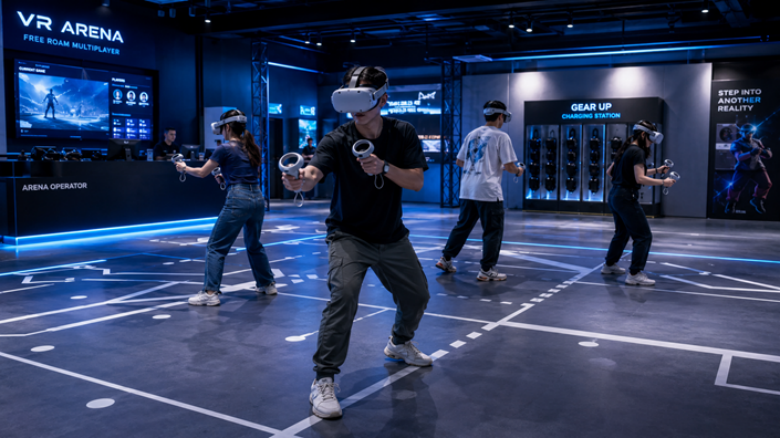
What actually sits inside the budget
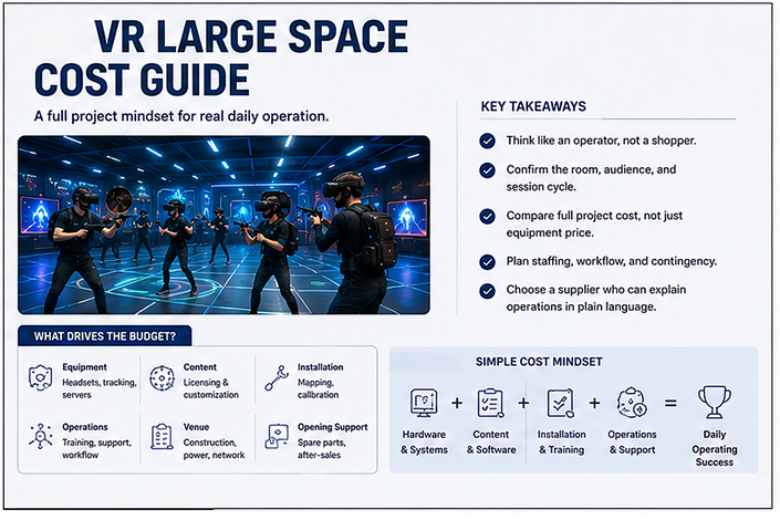
A commercial VR Large Space project usually has several cost layers. The visible layer includes headsets, controllers or props, tracking equipment, computing, networking, charging, and operator monitors. The less visible layer includes room mapping, calibration, content licensing or customization, staff training, safety planning, spare parts, and opening support.
Then comes the owner’s side. Flooring, walls, ventilation, power, lighting, signage, queue barriers, sound treatment, ticketing connection, and local construction work may not sit inside the supplier quote. I have seen buyers compare two offers and think one is cheaper, only to discover that the cheaper one left half of the venue work outside the document.
Cost changes with operating model
A small game room for light traffic is not the same purchase as a multiplayer VR arena built for weekend peaks. If the venue expects 6-10 players per round, the tracking layout, staff workflow, cleaning area, and content design must support that rhythm. If the venue only has room for 2-4 players, the buyer should not pretend it is a large-space attraction just because the brochure uses the phrase.
Session length matters too. A 10-minute game may become a 15-minute operating cycle after onboarding, headset adjustment, safety instruction, exit, cleaning, and reset. Any cost guide that ignores cycle time will give a false sense of payback.
Staffing is another quiet cost. Many venues assume the same employee can sell tickets, brief players, watch the game, clean equipment, and solve small faults. That may work in a slow hour. During a weekend peak, it turns into queue delay. A practical plan usually gives one person clear responsibility for front-desk sales and another for session operation when traffic is heavy.
A buying checklist before asking for a quote
- Define the target audience: families, teenagers, mall visitors, tourists, parties, or corporate groups.
- Measure the usable room, not the gross leased area.
- Decide the player count per session and a realistic session cycle.
- Separate supplier scope from owner-side construction and decoration.
- Ask what content is included at launch and how future updates work.
- Reserve a practical contingency for site changes, spare parts, and opening support.
Where buyers overspend or underspend
Overspending often happens when the buyer pays for a larger format than the traffic can feed. A small venue with weak weekday flow may be better with a compact VR arena or a smaller multiplayer setup. Underspending happens when the buyer saves on tracking, room design, or staff workflow. The result may open, but it feels fragile in real operation.
There is a middle mistake as well: buying good equipment and placing it in a bad corner. VR Large Space needs visibility. Visitors should understand from the outside that this is a group mission, not a private technical demo. Storefront design, waiting flow, and sound control are part of conversion, even if they sit outside the VR invoice.
The better cost decision is boring in the best way. Confirm the room. Confirm the audience. Confirm the session cycle. Then ask MiXR or another VR Large Space supplier to quote the full attraction package, including installation and operating handover. A lower equipment list is not always a lower project cost.
If the venue is still unsure, ask for two scopes: a conservative launch version and a stronger expansion version. This makes the decision cleaner. The buyer can see which items are essential on day one and which items can wait until traffic proves itself.
This also protects the sales conversation. When the owner knows which items are optional, they can negotiate without cutting into tracking reliability, safety, or staff workflow.
The rule I would use
Do not buy VR Large Space as equipment first. Buy it as a daily operating product. If the supplier can explain player flow, capacity, tracking limits, content refresh, maintenance, and staff training in plain language, the quote is worth studying. If the conversation stops at headset specifications, the buyer is still missing the real cost picture.