VR Arena vs Free Roam VR
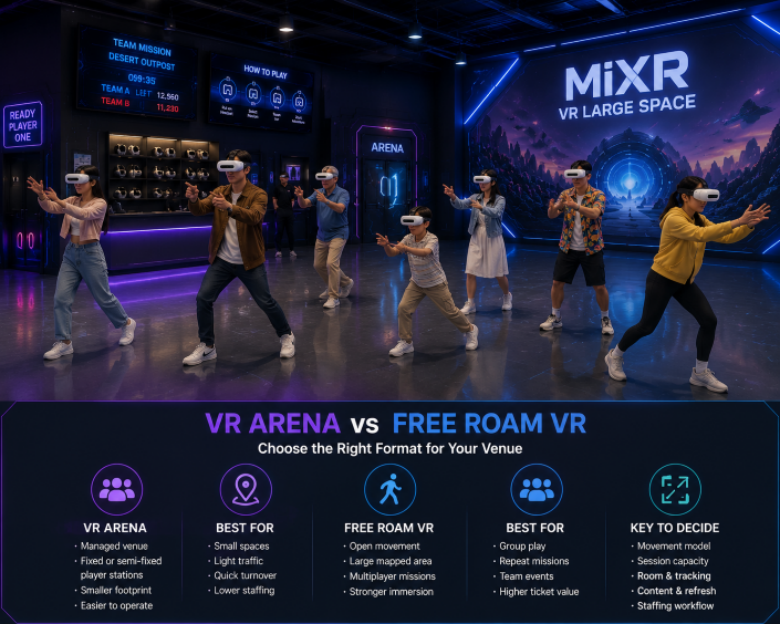
VR Arena vs Free Roam VR is a comparison that buyers often frame too sharply. In practice, a VR arena is the managed physical venue, while free roam VR describes how players move inside the experience. Many free roam systems operate inside an arena. The real question is whether the project should be designed around fixed player positions, guided movement, or open multiplayer movement.
For commercial buyers, the terminology matters because suppliers may use it differently. One vendor may call a small room with several standing stations a VR arena. Another may use the same term for a large mapped battlefield. Before comparing offers, define the movement model, session size, room requirement, content type, and staffing workflow.
What a VR arena usually means
A VR arena is a dedicated zone for location-based VR entertainment. It may include several headset stations, a compact battle area, or a larger room where players move in teams. The buyer is mainly purchasing a managed attraction space: entry, onboarding, gameplay, monitoring, and reset.
The strength of a VR arena is control. It gives the venue a clear place to sell the experience, manage equipment, and build a brand around group play. It can be installed in shopping malls, family entertainment centers, indoor parks, and tourism retail blocks. The weakness is that the term alone tells you almost nothing about the actual technical quality.
For a buyer, a VR arena proposal should always be translated into plain operating language. How many players enter per round? Are they standing, walking, or moving freely? Does the system need a staff member inside the room, outside the room, or both? What happens if one player removes the headset halfway through the session?
What free roam VR adds
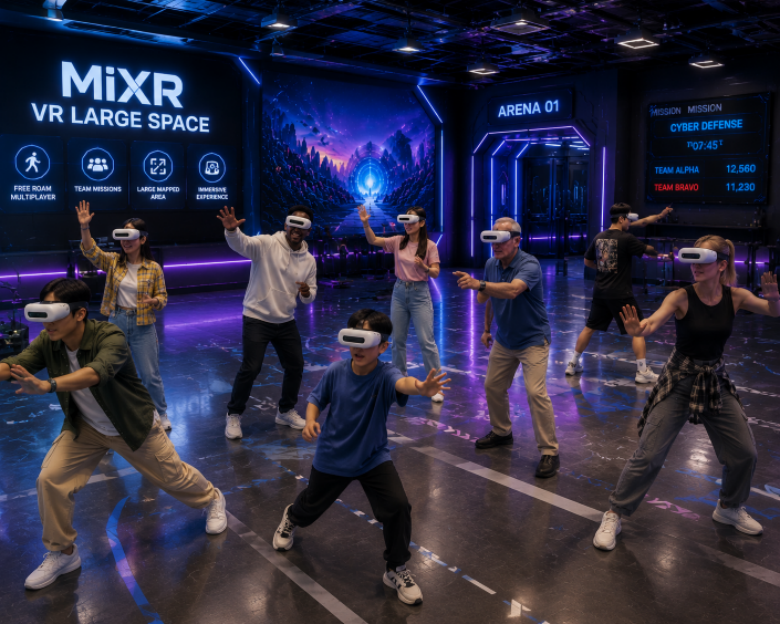
Free roam VR lets players physically walk through the mapped area. They are not sitting in a chair or standing in one fixed spot. This gives the experience a stronger body feeling and makes team missions more natural. It also raises the requirements for tracking, room layout, safety design, and staff supervision.
MiXR’s VR Large Space solution belongs in this free roam VR and multiplayer VR experience category. It is designed for venues that want a real location-based VR attraction, not a row of isolated headset booths. That difference affects how the buyer should think about space, content refresh, and operating rhythm.
How to choose between them
- Choose fixed or semi-fixed VR stations when the room is small and traffic is light.
- Choose a compact VR arena when the venue wants group play but has limited floor area.
- Choose free roam VR when movement, teamwork, and repeat missions are central to the attraction.
- Avoid large free roam setups when staffing, ventilation, or queue control is weak.
- Ask suppliers to describe real session capacity, not just maximum player count.
- Compare content refresh options before comparing headset models.
Business differences buyers should notice
Free roam VR usually creates stronger social energy. That helps birthday parties, youth groups, corporate team events, and repeat players. A simpler VR arena can still work well if the venue needs lower staff pressure or a smaller footprint. There is no universal winner.
The buyer should also think about cleaning and turnover. More movement and more props can mean more equipment handling. If the attraction is placed in a mall with heavy weekend traffic, staff training and reset design matter as much as the game trailer.
Marketing is different too. A fixed VR arena can be sold as a quick experience or arcade-style attraction. Free roam VR is easier to package as a team mission, birthday event, company challenge, or premium session. That difference may matter more than the hardware difference for the venue’s revenue plan.
Room shape can make the choice for you. Long narrow spaces, low ceilings, or columns may limit free movement. A square open room usually gives the designer more freedom.
The label on the proposal is not enough
I would not accept a proposal that says only VR arena or free roam VR without a floor plan, session cycle, tracking explanation, content list, and staff workflow. The venue is buying a business format. A label cannot show whether the attraction will run cleanly during a crowded Saturday.
A practical decision
If your goal is quick trial traffic and a small footprint, a simpler VR arena may be fine. If your goal is repeat group play, stronger ticket value, and a more memorable multiplayer attraction, free roam VR deserves the extra planning. For many commercial venues, MiXR’s VR Large Space format is worth considering because it connects the free roam experience with installation and operational support.
The better choice is the one your staff can operate and your visitors can understand. Once those two conditions are clear, the technical comparison becomes much easier.