Why Theme Parks and Tourism Operators Are Choosing XR Attractions
Theme parks and tourism operators are choosing XR attractions because they need experiences that can work inside existing visitor flows. The old answer to growth was often more land, bigger rides, or another outdoor show. Those options still matter, but they are slow, expensive, and sensitive to weather. XR attractions give operators another tool: a controllable experience that can be installed in a defined space and adapted to a specific audience.
This does not mean every operator should buy the same XR product. A park may need a Hyper XR Theater. A scenic area may need a Flying Theater or Glass Theater. A mall-style tourism block may be better served by VR Large Space. The reason for choosing XR should come before the equipment.
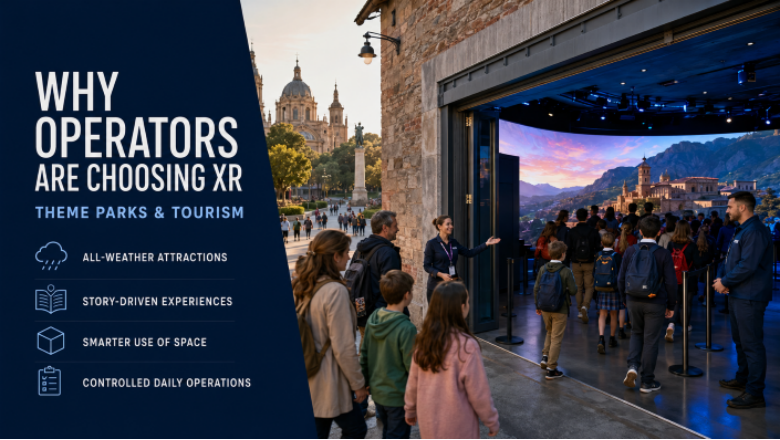
XR helps solve several operating problems
The first problem is weather. Indoor immersive attractions can keep visitors spending time on site when outdoor areas are uncomfortable. The second is storytelling. Many destinations have rich cultural material, but visitors do not always feel it during a normal walk. The third is capacity smoothing. A scheduled XR attraction can pull visitors into a controlled zone and reduce pressure on crowded outdoor points.
The fourth problem is marketing. A well-designed XR experience gives the sales team something concrete to package: family tickets, evening sessions, study tours, group bookings, holiday events, or VIP routes. That is more useful than a technology display with no business format.
There is also a land-use reason. Many operators have rooms, old exhibit areas, or underperforming indoor corners that are too valuable to leave passive but too small for a major ride. XR attractions can turn those areas into scheduled experiences when the ceiling height, power, safety route, and visitor access are suitable.
What operators are really buying
- A visitor journey: where guests notice, decide, queue, enter, experience, and leave.
- A revenue point: add-on ticket, bundled package, group product, or premium session.
- A content asset: local story, fantasy route, mission, or educational module.
- A controllable operation: staff roles, show cycles, safety reminders, cleaning, and reset.
- A support path: spare parts, training, remote help, updates, and maintenance habits.
That is why comparing XR attraction suppliers by hardware alone can mislead buyers. The same headset, screen, or projector can create very different visitor results depending on planning and integration.
Where XR attractions fit best
Theme parks usually benefit when XR fills an indoor gap or adds a family-friendly experience that does not require a major ride foundation. Tourism operators benefit when XR gives shape to a local story or creates a paid product for weak time periods. Museums benefit when XR explains invisible history, science, or culture without turning the whole space into a game hall.
MiXR can support this type of procurement conversation because its product line covers several immersive attraction formats. For this topic, the important point is not to mention every product. It is to choose the format that matches the site. Hyper XR Theater is suited to group immersive storytelling. VR Large Space is stronger for multiplayer action and repeat youth traffic.
The buyer should also decide whether the attraction is meant to be a headline product or a supporting product. A headline product needs stronger facade design, media assets, pre-opening promotion, and staff training. A supporting product can be smaller, but it still needs a clear reason to exist inside the route.
Operator readiness is just as important as supplier capability. If the owner has no ticketing plan, no marketing owner, and no staff schedule, even a well-built XR attraction will struggle. The buyer should assign these responsibilities before installation begins, because the first weeks after opening are too busy for basic role negotiation.
A good supplier can advise on these items, but the venue still has to own the daily business decisions.
Where XR is a poor choice
XR is not a cure for a bad location inside the park, a weak visitor path, or a site with no staff capacity. It is also risky when the operator wants a custom story but has no content approval process. A supplier can build a system. The owner still has to define the commercial role and operate it every day.
The procurement shift
Operators are becoming more practical. They ask about capacity, downtime, refresh plans, and training earlier in the discussion. That is healthy. The better XR attraction supplier should welcome those questions because they show the buyer is thinking like an operator.
The reason theme parks and tourism operators are choosing XR attractions is not that XR is new. It is that the right format can turn underused indoor space, local culture, and controlled media into a repeatable visitor product. When the attraction is planned around a real site problem, it has a stronger chance of surviving beyond opening-season curiosity.