Future of Immersive Entertainment for Theme Parks and Tourism Operators
The future of immersive entertainment for theme parks and tourism operators will be less about bigger screens and more about better operating logic. Visitors still enjoy spectacle, but operators now need attractions that can handle weather risk, shorter attention spans, group traffic, staffing pressure, and repeat marketing. A beautiful immersive room that cannot move people, refresh content, or support revenue is no longer enough.
In 2026, the stronger projects are being planned around visitor problems. A park may need an indoor attraction that absorbs families during rain. A cultural tourism site may need a night-time product that does not require a full outdoor parade. A museum may need a more physical way to explain a story. The technology is only useful when it answers that kind of problem.
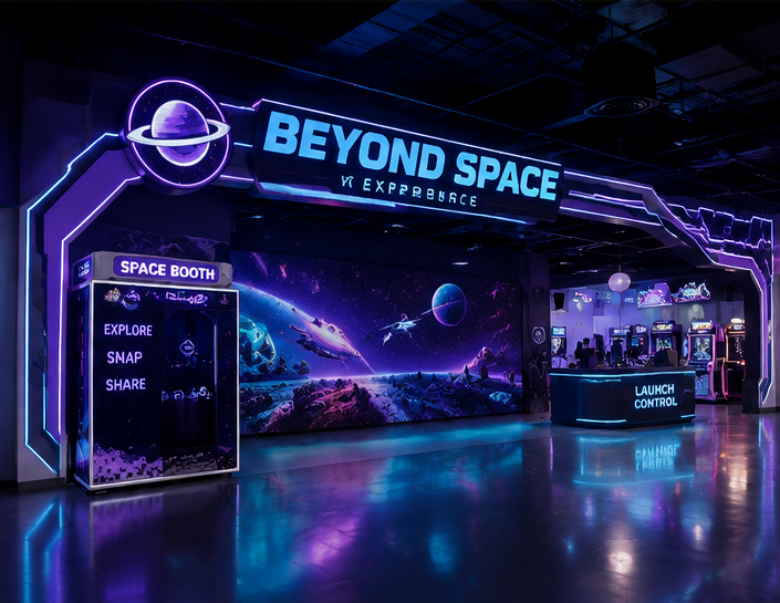
Immersive entertainment is becoming an operating tool
For years, many venues treated immersive technology as a visual upgrade. Add projection, add LED, add sensors, and the room looked new. That approach still creates photos, but it often fails to create a business unit. Operators are becoming more careful because installation budgets, staff time, and visitor expectations have all become harder to ignore.
The next wave will favor attractions that can be scheduled, maintained, explained quickly, and refreshed without rebuilding the whole space. Hyper XR Theater, VR Large Space, Flying Theater, and interactive museum systems all have a place, but they do not solve the same problem. Choosing one because it looks fashionable is a weak procurement method.
Procurement teams are also becoming less patient with black-box proposals. They want to know who owns content updates, who supports the control system, how fast a fault can be diagnosed, and which site conditions must be ready before the supplier arrives. That attitude is healthy. It pushes immersive entertainment closer to normal attraction engineering.
What will matter more over the next few years
- Controlled capacity: attractions must move visitors at a predictable pace.
- Content flexibility: operators need seasonal updates, local story modules, or campaign versions.
- Staff simplicity: the system should run under normal venue teams, not only engineers.
- Mixed audiences: families, tourists, youth groups, and school groups may all use the same venue differently.
- Weather protection: indoor or semi-indoor attractions reduce pressure on outdoor assets.
- Supplier accountability: buyers will prefer partners who connect hardware, content, installation, and training.
Theme parks will still need physical emotion
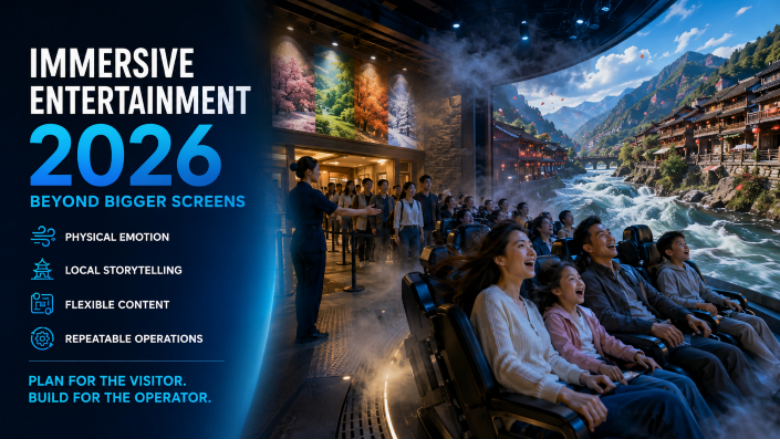
XR should not remove the physical side of a theme park. The best immersive attractions still give the body something to feel: motion, scale, sound, air, seat effect, shared audience reaction, or the freedom to walk with a team. Pure screen viewing is easier to copy and easier to forget.
This is why MiXR’s Hyper XR Theater can be relevant for parks that want a shared indoor experience rather than a headset-only product. It can support group storytelling, controlled show cycles, and a stronger sense of attraction design. It is not the answer for every park, but it fits the direction of practical immersive entertainment: more repeatable, more operable, and less dependent on a one-time visual surprise.
Tourism operators should protect the local story
Cultural tourism has a different challenge. The visitor may come for a mountain, a historic district, a famous figure, or a regional identity. If the immersive attraction feels generic, it may still sell tickets for a while, but it will not strengthen the destination. The story has to belong to the place.
That does not always mean a fully custom production from zero. Many operators can use a proven attraction format and customize the narrative layer, visual references, language, music, or pre-show. This protects the budget while keeping the experience from feeling like a rented technology exhibit.
Where the future will punish weak planning
Operators should be careful with attractions that require heavy staff, complex visitor instruction, or constant troubleshooting. A show that works in a supplier demo room may struggle during a holiday rush if the loading process is slow or the room has poor ventilation. Future-proofing is partly about boring items: access panels, spare parts, training, and service response.
There is also a content risk. A venue can spend heavily on a launch show and then leave it unchanged for too long. Visitors may still respect the production, but repeat value drops. Future-ready projects should leave room for partial updates: language versions, holiday scenes, new missions, local campaigns, or a revised pre-show.
That is where planning discipline beats pure spectacle.
For theme parks and tourism operators, immersive entertainment will keep growing because it can turn space, media, and story into ticketed experience. The winners will not be the venues that buy the most technology. They will be the ones that choose a format with a clear job, a real operating model, and a supplier who understands what happens after opening week.