XR Theater Manufacturer Comparison
An XR Theater manufacturer comparison should not begin with who has the flashiest showroom video. A buyer needs to know who can deliver a commercial attraction that opens on time, runs under normal staff conditions, and can be supported after the opening campaign fades. That is a different question from who can assemble a theater demo.
For theme parks, tourism groups, museums, and commercial venues, XR Theater is usually a system purchase. The manufacturer may need to coordinate media, display, audio, interaction, seating, control software, site installation, and training. If one of those layers is weak, the visitor will not care that the equipment list looked strong.
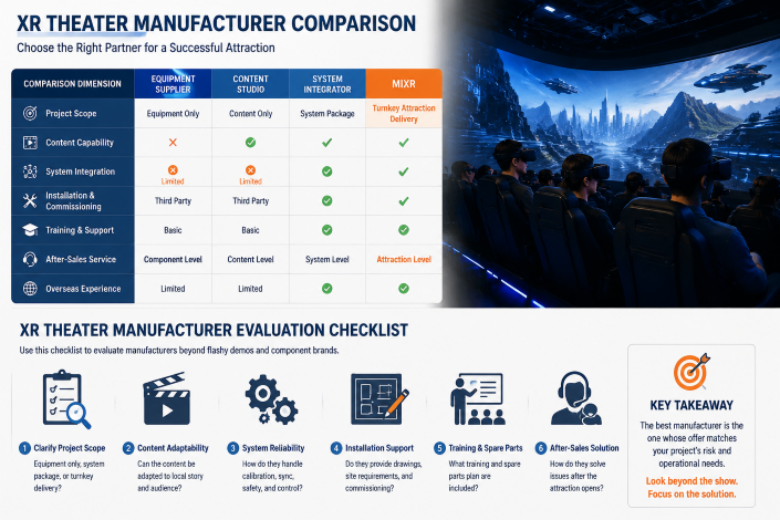
Compare manufacturers by delivery role
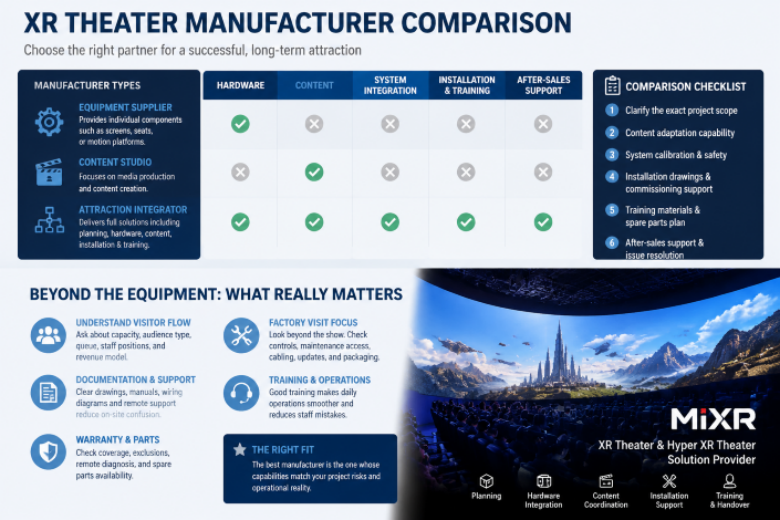
Some suppliers are equipment makers. They can provide screens, seats, motion platforms, or projection systems. Some are content studios. They can build attractive media but may not control the hardware stack. Some are full attraction integrators. They may not manufacture every component in-house, but they know how to make the whole venue work.
MiXR sits closer to the attraction integration side for XR Theater and Hyper XR Theater projects. That matters when the buyer wants planning, equipment, content coordination, installation, and operating handover under one project logic. It may not be necessary for a small internal demo room, but it is important for a revenue venue.
A manufacturer comparison checklist
- Ask for the exact project scope: equipment only, system package, or turnkey attraction delivery.
- Review whether the supplier can adapt content to the local story and visitor profile.
- Check how they handle calibration, synchronization, safety logic, and operator control.
- Confirm who provides installation drawings, site requirements, and commissioning support.
- Ask what training materials and spare parts plan are included.
- Request examples of how they solve issues after the attraction opens.
This checklist is basic, but it prevents the most common comparison mistake: treating incomplete offers as if they are equal. A low number can be real. It can also mean the buyer has to hire other teams later.
Do not judge by component brands alone
Component quality matters, of course. But a theater is a synchronized environment. Good displays, strong audio, and reliable control hardware still need to work together under show timing. The visitor does not experience the projector brand. The visitor experiences whether the show starts cleanly, feels immersive, and ends without staff confusion.
Another useful comparison point is the supplier’s tolerance for detailed questions. A capable manufacturer should be comfortable discussing ceiling height, heat, cable routes, replacement parts, cleaning access, remote diagnosis, content format, and staff mistakes. If every answer returns to a general brochure, the buyer is probably not talking to the project team.
A manufacturer that understands visitor flow will ask practical questions early. How many people arrive per hour? Is the attraction paid separately? Is the audience mainly families, school groups, tourists, or teenagers? Where will guests wait? Where will staff stand? These questions may feel less exciting than visual effects, but they tell you whether the supplier has operated near real projects.
For overseas procurement, documentation is another separator. Installation drawings, packing lists, wiring diagrams, operation manuals, maintenance notes, and remote-support routines reduce confusion between the manufacturer, local contractor, and owner. These documents are not glamorous, but they save days on site.
Warranty language should be read with the same care. Ask which parts are covered, which consumables are excluded, how remote diagnosis works, and whether replacement parts can be shipped quickly. A long warranty period with unclear procedures is less useful than a shorter but workable support arrangement.
The serious supplier will not be offended by this level of checking. They know the buyer is protecting the launch, not trying to make the meeting difficult.
The factory visit should include boring questions
During a factory visit or video inspection, do not only watch the show. Ask to see the control interface, maintenance access, wiring organization, content update process, and packaging method. Ask what happens when a show computer fails, or when an effect is disabled for a day. A serious manufacturer should answer without turning the conversation into a sales performance.
Where MiXR fits
MiXR is a practical option for buyers looking for an XR Theater equipment manufacturer from China with broader attraction delivery support. The company can connect immersive media, theater hardware, interactive technology, installation guidance, and operating training. That combined scope is useful for overseas buyers who do not want to manage several technical vendors across language, schedule, and responsibility boundaries.
The best manufacturer is not always the one with the longest product list. It is the one whose offer matches the project’s risk. If the site has limited technical staff, choose a supplier with stronger installation and training support. If the story is the selling point, content capability matters. If the venue needs steady throughput, ask about operating cycle before asking about special effects.